Slow leaks are the common kind
A dishwasher rarely fails as dramatically as a washer hose. More often a gasket hardens, an inlet connection weeps, or a drain hose loop loosens, and a small amount of water escapes each cycle. The water follows the path of least resistance: down the cabinet side, across the subfloor, and under neighboring cabinets and flooring. By the time the toe-kick swells or the floor lifts, weeks of cycles may have contributed.
Kitchens in Arvada ranch homes and bi-levels often have the dishwasher against the sink base with a basement or crawl space beneath or a slab. Newer two-stories can have a finished ceiling under the kitchen. Knowing which you have tells you where to look for secondary signs.
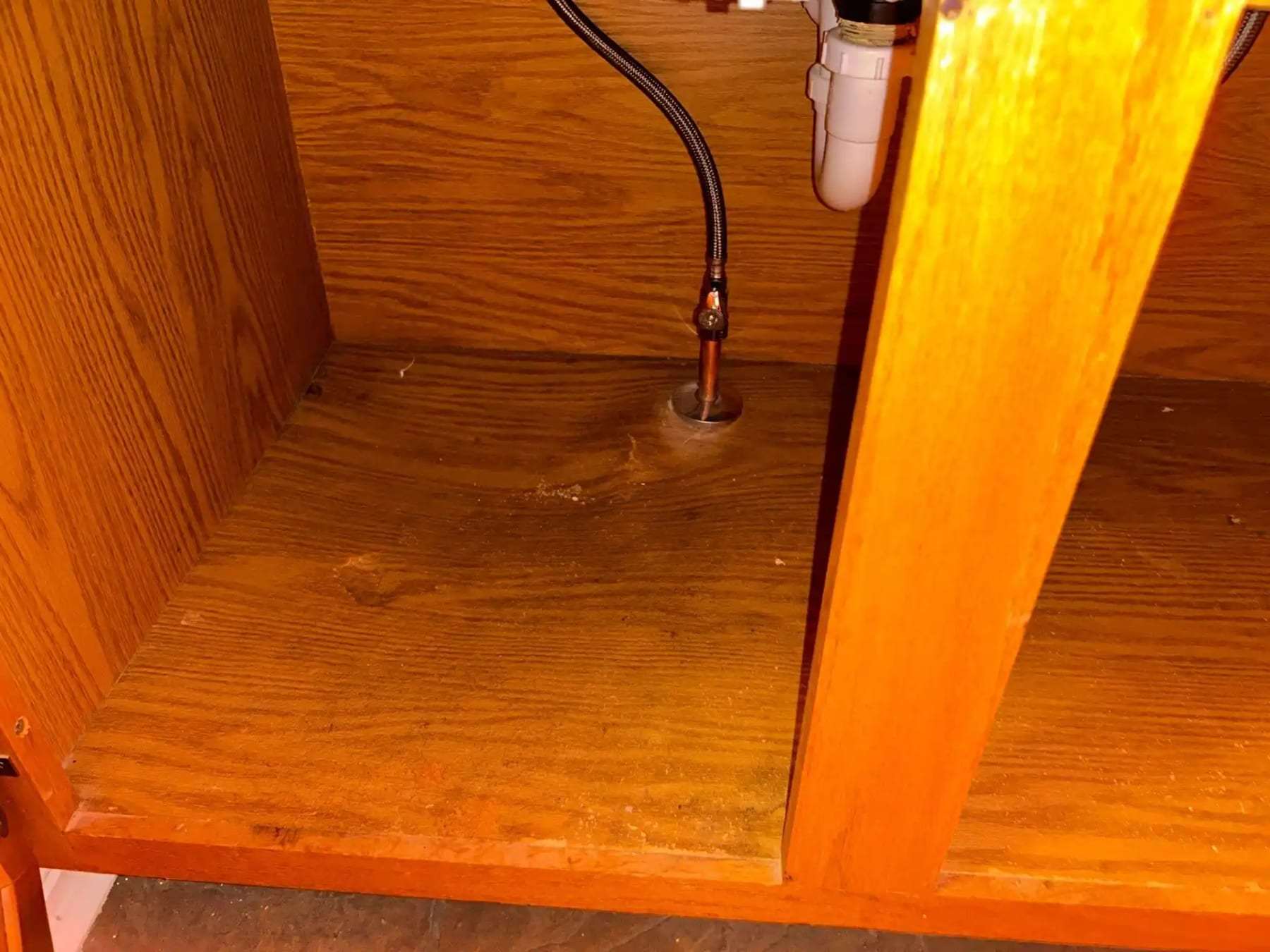
Water staining on the floor of a cabinet under a kitchen sink. Illustrative only: this photo is not from a job tied to this site or a specific address.
How a slow leak tends to show itself
Not every home follows this order, but the pattern is common.
- First weeks
- A faint musty smell near the sink; maybe a soft spot in the flooring edge by the machine.
- Next weeks
- Flooring seam lifts or edges cup; the toe-kick paint bubbles.
- Later
- Cabinet base swells, particleboard crumbles, a dark stain appears under the sink.
- Eventually
- Ceiling stain below, or mold odor from the floor system.
Common sources and how they differ
| Source | Typical sign | Who usually fixes it |
|---|---|---|
| Door gasket or latch | Water at the front on the floor during or after a cycle | Appliance technician or owner replacing a part |
| Inlet valve or supply connection | Wetness under the front lower panel, even when idle | Appliance technician or plumber |
| Drain hose or air gap | Water under the sink, odd smells, slow drainage | Plumber or appliance technician |
| Pump or tub seam | Leak only during certain cycle phases | Appliance technician |
What to check without taking the machine apart
Switch off the dishwasher breaker before reaching behind it.
- Press along the floor in front of the machine for a spongy feel
- Shine a light into the sink base and look at the drain connections
- Look at the cabinet side panel for dark tide lines
- Feel the toe-kick for swelling
- Check the shutoff valve under the sink for drips
Planning the drying
If the floor and cabinet base are wet, the drying contractor's moisture readings should extend beyond the visible damaged spot, across the kitchen. Ask whether toe-kicks will be pulled, whether the dishwasher needs to be moved so air reaches the cavity, and how the subfloor will be checked. Laminate and engineered products often react differently than tile, which is why identification of the flooring matters before anyone promises a result.
Common questions
Is a dishwasher leak a plumbing or an appliance problem?
It can be either. A supply or drain connection is often plumbing; a gasket or pump is an appliance repair.
Can the cabinet base be saved?
Solid wood often dries and recovers better than swollen particleboard. Moisture readings and an inspection after drying decide it.
General information for Arvada, not a quote or professional advice. In an emergency, call 911.