Inspection form
| Item | What good looks like | What you saw |
|---|---|---|
| Drain pan | Present, dry, no rust or cracks | |
| Pan drain line | Slopes to a safe drain, not blocked or kinked | |
| T&P discharge pipe | Open, pointed downward, dry | |
| Tank base | No rust, dampness or crust | |
| Inlet and outlet fittings | Dry, no mineral crust | |
| Cold inlet valve | Reachable and turns freely | |
| Floor nearby | Dry, no staining | |
| Stored items | Raised off the floor |
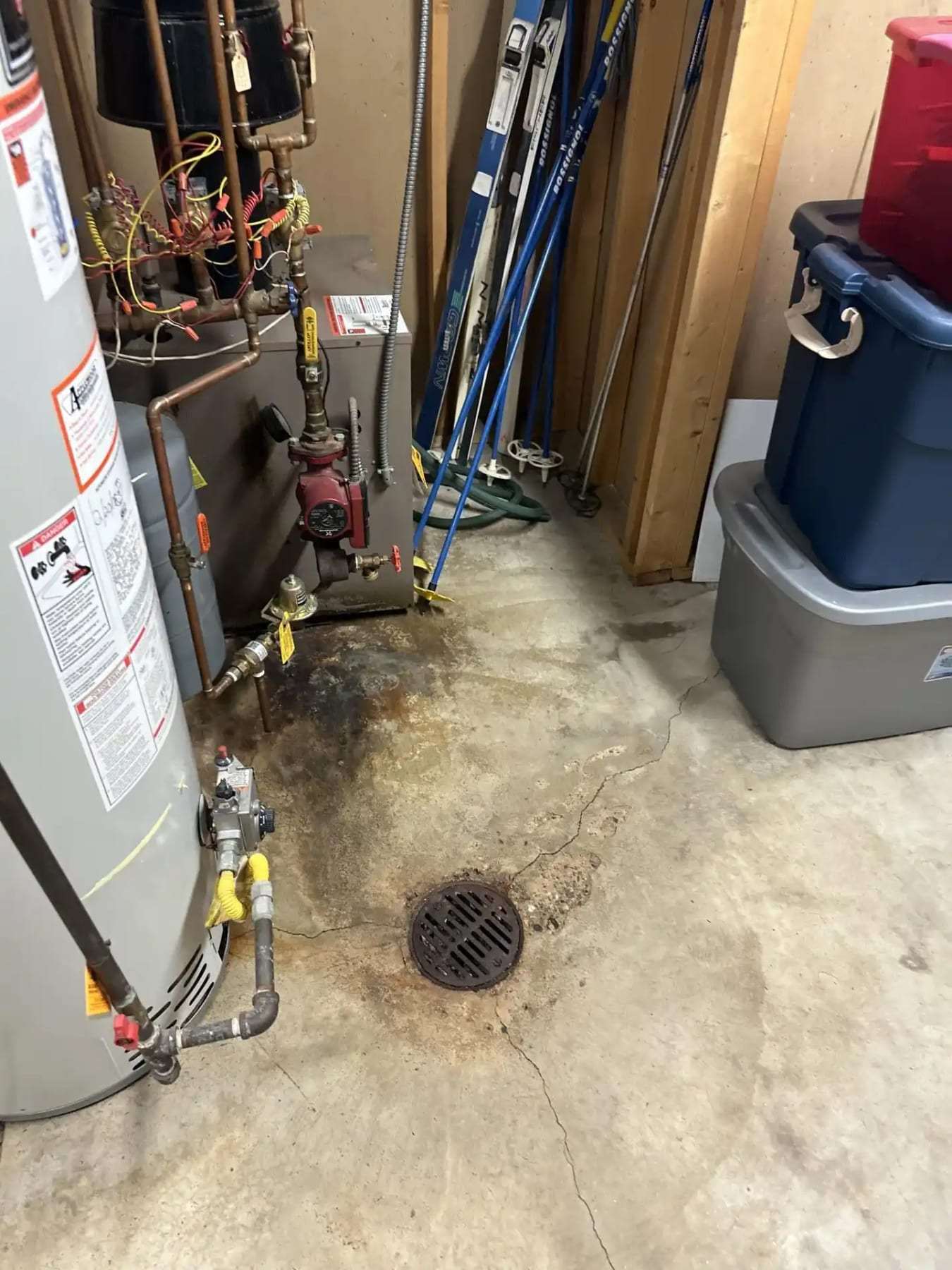
Water heater with a leak at the drain valve beside a floor drain. One example of what this stage can look like; it is not a job connected to this site.
About the pan
A drain pan sits under the heater to catch small drips. It cannot handle a tank failure unless it has a drain line to a safe place, and many pans without one simply fill and overflow. The pan's size and the pipe should be described by the installer. Local code may govern the details; ask a plumber or the city's building department what applies to your address, and do not assume either way.
Notes for the plumber
- Age of the heater from the nameplate
- Any rumbling or popping
- Any change in hot water
- Rust on the tank or fittings
- Whether a pan or sensor is present
- Where the discharge pipe ends
What to do with results
- IfPan holds waterFind the source; a plumber may need to look at the tank.
- IfDrain line is blockedClear it or ask a plumber.
- IfNo pan at allAsk an installer about adding a pan with a drain, and a sensor.
- IfRelief pipe is cappedHave a plumber correct it.
Repeat the check
Do it at least twice a year, and add it to the seasonal list. A short form with dates turns into a useful record if the heater ever leaks.
Photograph the pan, the discharge pipe end and the nameplate each time you do the check, and store the photos with the form. Over several years the pictures show whether rust is spreading or a stain is growing. If a plumber visits, share them; they can speed a diagnosis.
If you add a pan during a replacement, ask the installer to explain where its drain line ends and how you can tell it is clear. A drain line that ends at a spot you cannot see is hard to monitor, so a visible end point is worth requesting.
If your heater sits on a platform or stand, check that the stand is level and dry as well, because a tilted tank can drip in an odd direction and leave a puddle away from the source.
General information for Arvada, not a quote or professional advice. In an emergency, call 911.