Why the hoses are the weak point
A washer has two supply hoses, one hot and one cold, and both stay under full household pressure whether or not a cycle is running. The machine itself is built to hold water; the hoses and their couplings are the parts that age. Rubber hardens, collars corrode, and a hose pushed tight against a wall can kink at the elbow. When one gives way at the faucet end, the water comes out at line pressure, not as a trickle.
In Arvada, laundry rooms sit in three common places: a main-floor closet in ranch and bi-level houses, a basement utility area, and an upstairs room in newer two-stories. The location matters more than the brand of hose, because it decides whether escaping water meets a floor drain, a finished ceiling, or a bedroom carpet.
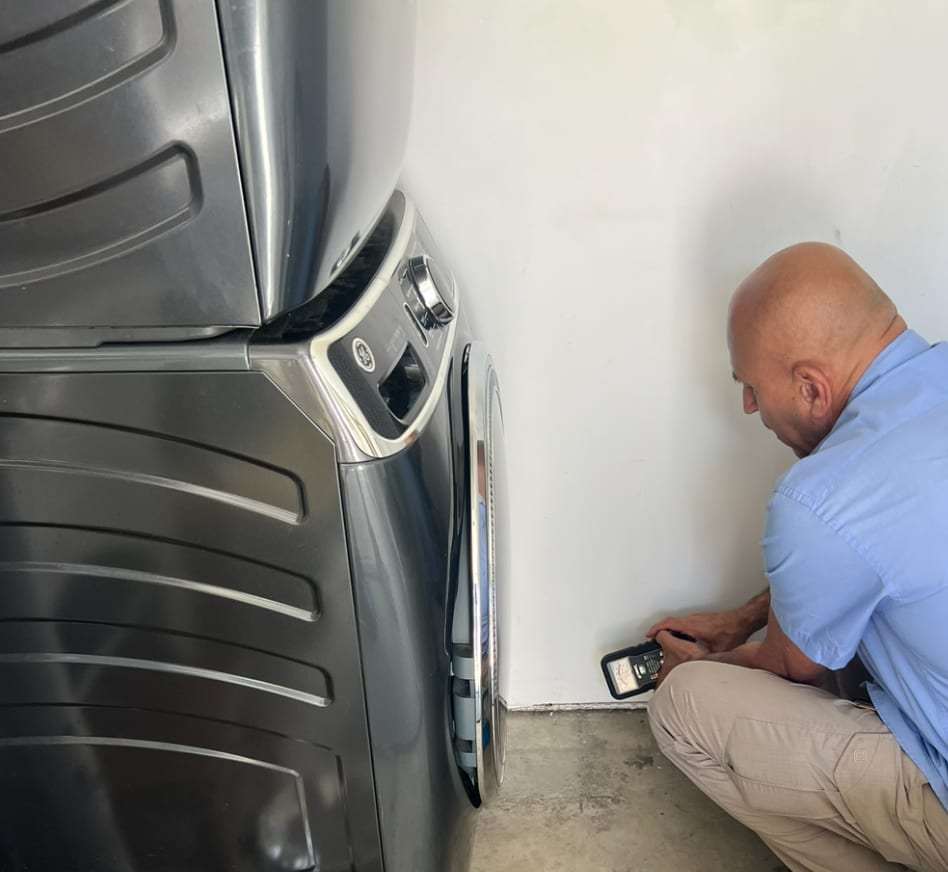
Inspector checking moisture at the base of a wall beside a washer. Illustrative only: this photo is not from a job tied to this site or a specific address.
What a hose check actually looks at
| Part | What to look for | What it suggests |
|---|---|---|
| Rubber hose body | Cracks, flattened sections, bulges near the ends | Material is breaking down; replacement is the usual answer |
| Braided hose cover | Rust-colored stains, frayed strands, kinks | Inner liner may be weakening under the cover |
| Coupling collars | White or green crust, rust, wet fingerprints | A slow seep at the threads that can run for weeks |
| Faucet valves | Stiff handles, drips at the stem | A valve that cannot shut off cleanly is its own problem |
| Floor behind washer | Staining, soft spot, musty smell | Past leakage, possibly hidden |
When a hose lets go: a sequence
These steps are general household guidance, not a substitute for instructions from the appliance maker.
Stop the water
Close both faucet valves behind the machine. If they will not turn or are underwater, go to the main shutoff for the house.
Make the area safe
Avoid electrical contact with standing water. Turn off the circuit from the panel only if the panel is dry and easy to reach.
Remove the bulk water
Towels, a mop and a wet vacuum handle the visible layer. Open the laundry room door and any closet doors to let air move.
Photograph before cleanup
Take wide and close photos of the failed hose, the faucet, the wet floor and any ceiling below.
Keep the failed part
Put the hose in a bag. An insurer or installer may want to see how it failed.
Replacing hoses on purpose
Many appliance makers suggest checking washer hoses every year or so and replacing them on a schedule, often a handful of years, though the exact interval is in the manual for your model. Braided stainless-covered hoses are a common upgrade, but they still have rubber washers and inner liners that age. Write the install date on the hose with a marker, or record it in a hose and tank age log, so the date is not a guess later.
Leave a few inches of slack and avoid pushing the machine tight against the wall, which kinks the elbow. Hand-tighten, then a partial turn with pliers, as the hose instructions describe; overtightening cracks the washer seat. Some households add an auto-shutoff device or a single-lever valve so closing the water after laundry day is one motion.
Questions worth settling before the next load
- Where are the two washer valves, and do they turn all the way?
- When were the hoses last replaced, and is that date written down?
- What is under the washer: finished floor, subfloor, a drain, or a ceiling below?
- Would anyone notice a leak while the house is empty or everyone is asleep?
Common questions
Should I turn the washer valves off after every load?
It is a layer of protection some households choose, since hoses are pressurized only while the valves are open. Whether it is practical depends on how reachable the valves are.
Does a burst hose mean the washer is damaged?
Not necessarily. The hose is a separate part. Ask an appliance technician to confirm after the area is dry and the machine is safe to run.
General information for Arvada, not a quote or professional advice. In an emergency, call 911.